Yesterday evening I opened my new issue of Wired magazine and was surprised to find a DVD of COMA, Crackle's new online series directed by P.R. Brown. Actually, what surprised me was that Sony (who owns Crackle.com) had the balls to promote original online programming in such a big way!
The show is banking that the star power of Michael Madsen and George Hamilton will drive eyeballs to the series. The free DVD proves that the studio is committed to spend some major bucks on marketing their series on traditional media platforms, such as print. I hope it works for them. It definitely got me curious. I'm sure Fox and Disney's Stage 9 is watching closely to see if Coma is successful. If so, I'm sure others will be stepping up to the plate soon with their own traditional marketing campaigns.
I guess the big question really is - how is the show? My one line reaction on the first episode: I thought it was huge on style, light on substance. A lot of work went into this series and it shows. I just wish more time was spent on the story. That's just my take. I've included the first episode below so you can make up your own mind. Enjoy!
One of the things I quickly learned once I started producing and directing after NYU, is that finding work is a mixture of talent, tenacity and luck (and not specifically in that order). The other lesson is that good work always leads to more good work.
In 2005, I was producing/directing/editing behind the scenes documentaries for DVDs. These were mostly for feature films and TV shows. I created material for Daredevil, The Shield, School Of Rock, The Commitments, The Harold Lloyd Box Set and many more.
Another project I happen to be working on was the TV show 24. I created a 90 minute documentary following the cast and crew as they created the season 2 finale. We shot the documentary in the style of the TV show: 2 cameras (one wide and close, the other telephoto and roving), snap zooms, backlighting, split frames, same sound fx, etc...
The piece came together and everyone on the show really thought we did a good job. At the same time, Fox had just made a deal with Verizon to create programming for their new 3G cell phones. They wanted to create a spin-off of 24. When the question came up to the producers of the show, "Who should we get to make the series?" Everyone said, "Get the DVD guy.".
Being able to play in the fiction sandbox again was a great experience. However, this whole endeavor was a big experiment. We were not going to be using the cast members from the TV show. Our budget was a fraction of the cost to produce one episode. We were doing this non-union.
Now that a few years have past, I can look back and see the shortfalls. The biggest problem was not having the cast. I'm not sure why someone would want to pay to see unknown actors when they can watch Kiefer for free every week on Fox. In this case, the rationale was that people would pay just to say they watch video on their phone (which was true at the time). However, the novelty of the 3G technology would quickly fade. Which leads to the next big issue. Just because the technology is there, doesn't mean people really want to watch TV on their cell phones - unless there is something that is truly unique about the experiencing the content on a phone than any other medium. This is one reason why the mobile content market has not caught on yet (especially for original programming). No one is creating anything that NEEDS to be seen on a cell phone in order for an audience to get the full impact of the story.
But at the end of the day, I was really proud of the work. Fox execs and the 24 producers were also happy. I thought our episodes had the same style and tone of the TV show, great production value, action and pacing. And it's always great to say you were the first at something. In this case, 24: Conspiracy was the first series made specifically for mobile phone. That year, we were nominated for an Emmy award in the new category of new media programming.
Here are a couple of "mobisodes" from the series. I hope you enjoy!
You gotta love how Will Ferrel is able to laugh at himself. This video really shows how stupid most comments can be when people have the opportunity to say something. It's a little sad, but Will always finds as way to turn that frown upside down.
Now, I wish someone would start leaving me comments - even if they are nasty, mean-spitrited, hate-filled rants. Or you could just say something inspiring...
What I love most about these two videos is how the handheld, amateur style is perfectly executed.
***SPOILER ALERT***: Watch the two videos before reading any further, unless you enjoy buzz kills.
With Stabbing at Leia's 22nd Birthday Party, you completely buy that this is a high-school party getting out of control until the light-sabers are broken out. It's a great turn and the action is well shot and editing is tight. Congrats to the editor who really did a great job with the quick pacing of the piece. Most of all, the effects blend really well into the shakey cam video.
Death Star Over SF is just a stunning piece of work that celebrates the often wondered fantasy "Dude, what if there was a Death Star instead of the moon?!" We get to see all our favorite machinery from the Star Wars movies displayed in real world settings. It's a geek dream come true. What I think works best is the laid back attitude the camera guy has about what he's filming, like it's no big deal. It's amateur cam at its finest and I just want to say to these filmmakers - BRAVO!
I think what these videos prove, and I know there are more like these out there, is how the power of George Lucas's imagination continues to inspire us to this day. The fantasy/sci-fi genre really taps into our belief and dreams that there is something out in the universe much greater than ourselves. These two video do an excellent job of making us feel like we are kids again. Hope you enjoy!
Crackle.com really knocks it out of the park with this web-series. For me, GAY TOWN is a great example of quality, original online entertainment.
Owen Benjamin created and stars in this series about the life of a straight man living in a very gay town. The success of this simple, high-concept comedy lies in its execution. The acting is solid, the jokes work while not trying so hard and production value is on par with anything you would see on television. However, underneath the surface, you can't help but catch the social message that is lurking in the closet. Yes, it's funny to watch a straight man get picked on, bullied, fired and outcast just because he's not like the other guys in town. But then you begin to realize how it can be at times for homosexuals living in the real world and what they have to put up with their entire lives... Which is why I think GAY TOWN is more that just a funny comedy, it slyly turns homophobia on its ass and gives it a good spanking. It takes a couple of episodes to get cranking, but I think the overall quality of these ten episodes really sets this series apart from the clutter.
Congrats to Owen and Crackle.com for producing an excellent series! Hope season two is a good as the first.
Here's the pilot I produced and directed for the original online series HALLMARK ACROSS AMERICA. This premiere episode focuses on MURDER MYSTERY WEEKEND. Stun Creative hired me for this great gig. It's been a long time since I had this much fun on a project. We were in the beautiful town of Langley, Washington. The town is about an hour north of Seattle on Whidbey Island. The people were really nice and everyone was very cool with us shooting there.
I had no idea what to expect going into this... It's always harder to try and find the story as it unfolds rather that just covering a simple event or competition. What I mean is that there were multiple narratives to this event - the story being amateur sleuths trying to figure out "who did it". There are a ton of stories happening all at the same time because there were thousands of people in town, all trying to figure out who the murderer was over two days... We needed to find interesting characters to follow within a few hours of shooting or we had no story. Other festivals, such as Alaska's ice sculpture competition, doesn't really have an unpredictable narrative. You know it is going to be teams of people carving ice all in a confined area. All you need to do was document a few teams carving ice and you were good to go.
It was important to Hallmark not only cover the event, but reveal the personalities of the people participating. I agreed totally with this. Getting into personalities is always more fun. Luckily there were a ton of great characters who came to Langley and we got a ton of video gold. We were all over the town, running from team to team, trying to follow their stories... I think this series can be a real winner. Please check it out by clicking the link below and let me know your thoughts!
...Before the deal was done with Eveo, I made sure they would pay for as many videos as I could possibly crank out. There was no minimum or maximum number. Each video could be just one piece or broken into several parts. This was key. I had total freedom. The one thing that was important to them is that the video was in focus (most of the time) and that there was audio. Period. I was unsure if they trusted my abilities or were completely out of their minds... Oh, and I got to keep the copyright and they would license the content. Not bad.
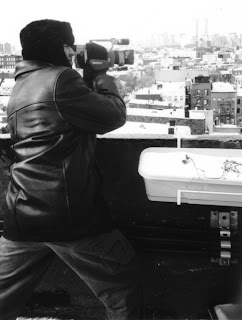
Once I got the go ahead, I called everyone I knew who was involved with the NYC art world or had a band that didn't suck. Part of the reason for pitching these series were because I went to a high-school of visual and performing arts in Miami called New World. I was still close with a bunch of people who were now breaking into the art or music world and thought this would be a great chance to highlight their work. Within an few days I had set up over a dozen shoots. It was the middle of winter and it was brutally cold in NY. I packed up my Sony TRV-900, ME66 shotgun mic, Arri light-kit and Russian fur hat and headed to NYC.
Most segments took two days to shoot. The first day was usually shooting b-roll of the artist or musician working... I was able to get familiar with their style and process. This allowed me to formulate questions for our interview which would usually happen on the second day. Most of the time, I realized that there was enough content to support two segments for each artist.
Once I started, I was soon being introduced to other artists, musicians, A&R execs, gallery owners, curators who all wanted to participate as well. It seemed each segment opened the door to two additional people to document.
The greatest discovery however was realizing how much people opened up if they didn't feel like there was pressure on them to deliver. Just being one guy with a camera, I think allowed people to let their guard down and just be themselves. There was an intimacy that I had never gotten before when working with a larger crew. Sure, when you have a team of people, the level of production value goes up (some of the time). I found the trade off was completely worth it. Getting great content from your subjects always trumps production value. Obviously, I tried my best to light things properly, get good audio and shoot with a steady hand and pick interesting angles, but nothing was more important than making sure the people I were taping were dynamic and fun to watch.
I also think my subjects saw that I was having a good time. And if I am having fun, there is no reason for them not to relax and have fun as well. When I would go on other shoots with larger crews, everything was always very professional and serious. Now, it was important to just relax, have fun and get the magic of the creative process.
The other major lesson I learned was that, being the shooter/producer as well as the editor, allowed me to shoot just enough so I could get a great segment. I didn't have to overshoot everything. Once I was in the editing room, the pieces came together fast. I knew where the best shots were. I could sometimes cut together two or three segments in a day.
To this day, I look back on those three weeks of shooting and realize that was the most fun I had creating a series. The initial fear I had that it was going to be crap because it wouldn't feel professional was crazy. Eveo wanted it to feel like an amateur made it. They wanted it grungy and homemade... Luckily, that's exactly what they got.
Within six weeks I delivered 33 segments - 20 on emerging artists, 13 on breaking bands. Eveo, I think was a bit shocked that I was able to crank out so many segments that quickly. They were very happy with the pieces, but more importantly, most of my subjects were also thrilled about their segments as well. That was a great payoff. Not to mention, I made ten grand. I think I was one of the first people hired to create original video content specifically for the Internet.
However, once the videos were up, it was clear that the technology was not yet ready for prime time. Most people still didn't have broadband and most computers took forever to stream a single piece of video. It wasn't long before the Internet bubble burst and many companies folded or changed their business model. It was a shame, because Eveo was really trying to make a great site that was about the democratization of video. It would take another six years till YouTube came along and proved that user generated content was a powerful creative force.
Here are a few segments for you to check out. I will add the complete series shortly. Hope you enjoy!
I fell in love with original online video from the start. It was 1999 and the first Internet wave was washing over the country. I was finishing up co-writing, producing and directing PRESERVING THE LEGACY, a three-year environmental documentary series for PBS. At 26, I had travelled the world and discovered the incredible ways we were quickly destroying the planet. This was years before it was cool to be aware about global warming. My friends hated hearing about nuclear waste, the population explosion, our carbon footprint, Superfund, air pollution and so on... Working on this series was an incredible experience, but left me with a feeling like I needed to create something on the lighter side once it was over.
At the time, broadband and video were the big buzz words and companies were sprouting up like weeds on the Internet to cash in on they hype. Start-ups were being given huge amounts of cash. They needed content and they needed it now. To me, as a filmmaker, the future was here. For the first time, advancements in digital-video cameras and online editing software made it possible to create stories that didn't have to cost a ton of money. Anyone could do it and that what companies were banking on...
I was pitching two series ideas. STUDIO VISITfollowed the creative process of emerging visual artists andLOCKOUT revealed the process of breaking bands. After three months of getting nowhere, Eveo came along.
Eveo was a startup based out of San Francisco and they were YouTube before there was a YouTube. They were betting that user-generated video content would be huge. However, before they launched their site they needed videos (which they called eveos) to be seeded on the site so they could show their potential audience what to make. They loved my ideas for LOCKOUT and STUDIO VISIT. Kids would see the videos, be inspired to make their own videos and then post them on the site. Great. Perfect. Let's make it happen!
The deal was fast and loose. Since they wanted my videos to inspire others to make their own, my videos needed to have a home-made feel. It was to be a one-man-band operation. Me shooting, doing sound, lighting, everything... They wanted me to make as many as I could as quickly as possible. I was going to get paid $300 per video. Each video was to be 2 - 4 minutes in length. I could do whatever I wanted as long as it was about breaking bands or emerging artists. I needed to be smart and plan ahead. If I wasn't careful, this process could become very painful and expensive. If done right, I would be able to tell some great stories and be able to make rent for a while. What followed was the most intensive filmmaking experience I've ever had in my life.
 Yesterday evening I opened my new issue of Wired magazine and was surprised to find a DVD of COMA, Crackle's new online series directed by P.R. Brown. Actually, what surprised me was that Sony (who owns Crackle.com) had the balls to promote original online programming in such a big way!